


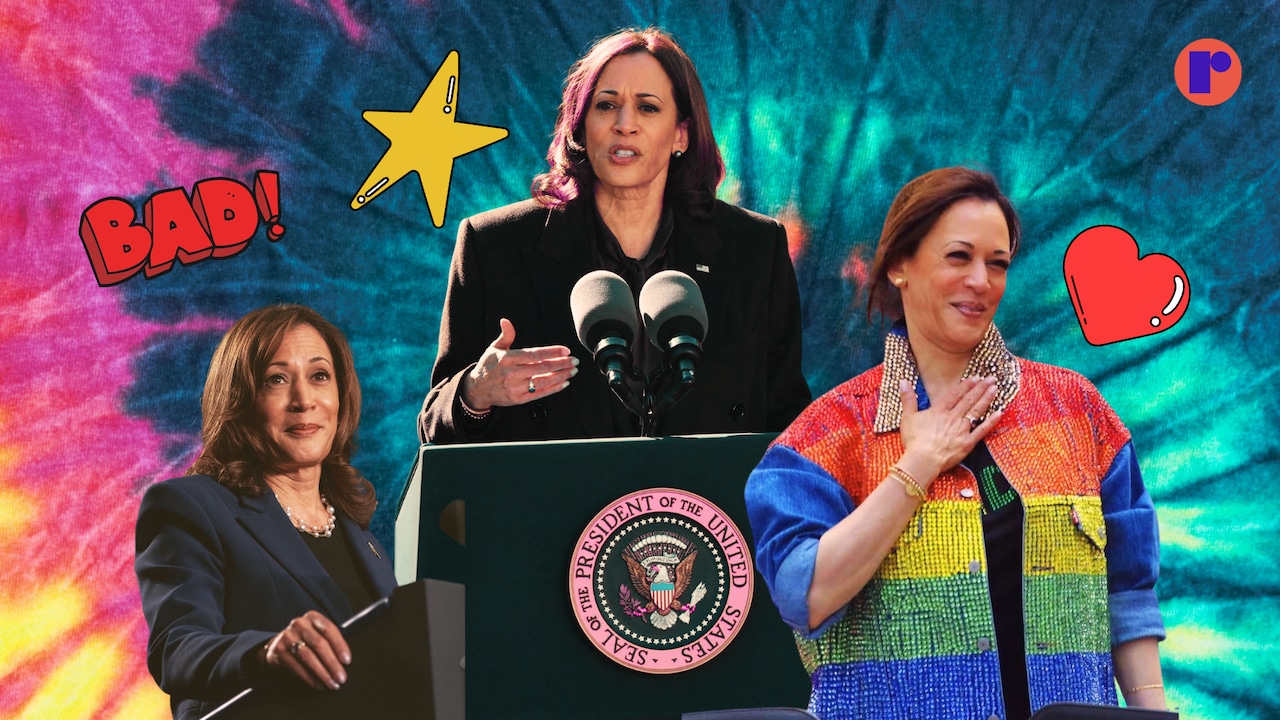

You think Vice President Kamala Harris just fell out of a coconut tree as a presidential candidate who will champion LGBTQ justice? First things first, let’s take a deep dive into the context of her history and relationship with the queer community.
Harris has had a sudden come-up as the Democratic presidential candidate since Pres. Joe Biden’s departure from this election’s race and his endorsement of her this Sunday. Not to mention the online discourse about the news of her candidacy in particular has her heavily intertwined with queer pop culture references.
From TikTokers using pop star Charli XCX—who has long had a loyal LGBTQ following— and her new album “Brat” to make fancams of Harris, to Harris’ actual HQ team on TikTok making videos with new queer breakout artist Chappell Roan’s music, memes utilizing gay pop culture seem to be working overtime to skyrocket her ratings. Just yesterday, her ratings surpassed Trump on a two percent margin ahead of his, according to Reuters.
But in a time where anti-trans vitriol is breaking record on the legislative floor with 625 bills this year targeting the community, what is the gap between Kamala’s pro-LGBTQ talking points and her history of involvement with legislation, policy and advocacy? Here’s Reckon’s roundup of the good, the bad and the questionable of Harris’ takes on queer justice.
The Good
For starters, Harris’ track record shows her unwavering support of gay marriage over a decade before it was federally legalized. In 2003, she was elected as district attorney for San Francisco, in which the city’s mayor Gavin Newsom declared gay marriage legal the following year.
Meanwhile, a video from 2010 is recirculating on X, the footage capturing the moment Harris, who was then the Attorney General in California, calling a local clerk in Los Angeles to immediately proceed with same-gender marriages following the halt of Proposition 8, which barred same-gender couples from legally marrying.
Resurfaced video shows Kamala Harris, then California Attorney General, instructing a Los Angeles clerk to begin gay marriages after Proposition 8 was halted in 2010.pic.twitter.com/mMMS5Cl4vQ
— Pop Crave (@PopCrave) July 23, 2024
“The original ally,” a user responded.
Additionally, Harris held a conference in California in 2006, bringing over 100 officials across the nation to discuss the ways to abolish the “gay panic” and “transgender panic” defense laws that consequentially protected perpetrators of anti-LGBTQ violence. By 2014, California became the first state to ban the practice in law, followed by Harris and various senators introducing a bill to prohibit the practice nationally.
The Bad
While she has stood at the forefront of marriage equality—compared to current Pres. Biden, whose stance on gay marriage evolved throughout Obama’s presidency when he was Vice President—Harris record on trans rights has community members feeling split.
Mainly, Harris faced criticism during her first presidential campaign in 2020, having her history of actions brought to light.
While district attorney in 2008, Harris opposed Proposition K, a measure that aimed to decriminalize sex work. “I think it’s completely ridiculous, just in case there’s any ambiguity about my position,” Harris explained at the time. “It would put a welcome mat out for pimps and prostitutes to come into San Francisco.
Sex work is an LGBTQ issue, according to Juana Maria Rodríguez, a U.C. Berkeley ethnic studies professor and author of “Puta Life: Seeing Latinas, Working Sex.” She notes that trans women are overrepresented in sex work, in which the profession itself makes it 200 times more likely to be a victim of homicide.
In another instance as attorney general, she rejected a request from Michelle Lael-Norsworthy, an incarcerated trans woman who sought gender-affirming surgery while serving time. Lael-Norsworthy sued California for failing to provide equitable healthcare, ultimately prompting a federal judge to order the state permission for her surgery.
As of 2022, nearly 125,000 incarcerated people in the U.S. are open about their LGBTQ identity, according to a study by The Sentencing Project, a Washington, D.C.-based research and advocacy center working for decarceration and addressing racial disparities in the criminal justice system.
In a brief from April 10, 2015, Harris, along with other state attorneys, argued against the federal judge’s order, saying that Lael-Norsworthy “has been receiving hormone therapy for her gender dysphoria since 2000 and continues to receive hormone therapy and other forms of treatment… there is no evidence that Norsworthy is in serious, immediate physical or emotional danger.”
Shiloh Quine was another incarcerated trans woman in a similar position as Lael-Norsworthy. New Orleans, La.-based founder and policy analyst at the currently-unlaunched startup Open Policy Forum, Corinne Green, was working at the nonprofit Transgender Law Center at the time. Green, who is a queer and asexual nonbinary transfemme, recalls opposing Harris and the state of California over their denial to provide gender-affirming care for incarcerated trans people.
Harris has since commented on this past, saying that she takes “full responsibility” and that she was simply following her work’s orders. For Green, it’s not enough.
“That’s not an acceptable excuse for me, nor is it any kind of apology for or recognition of the state’s abuse and her role in it,” she said, additionally mentioning Harris’ involvement with the website Backpage. In 2016, Harris charged Backpage with criminal human trafficking, and successfully helped enact FOSTA/SESTA in Congress, which drove sex workers off of the public and regulated internet.
In his 2019 op-ed, the now-deputy director of American Civil Liberties Union (ACLU) Chase Strangio wrote for Out Magazine that entailed his distrust in Harris.
“As a prosecutor, Harris’s work has been as an arm of the state fighting to lock people in cages and defending policies that destroyed lives and communities,” Strangio wrote in 2019. “Now attempting to position herself as a criminal legal system reformer and an ally to the LGBTQ+ community, Harris seeks to rewrite her past rather than own it. But I am not buying it.”
Hesitations aside, for Green, Harris’ lack of interjection against Pres. Biden’s support of Israel is ultimately her biggest concern.
“She had a moral duty to speak against, rather than co-sign, Biden’s genocide in Palestine,” she said, noting that Palestinian justice is intertwined with LGBTQ justice. “She didn’t. If she won’t violate the norms of decorum even to oppose the worst crime against humanity there is, I have no reason to believe she’s an effective leader on less pressing issues.”
The Questionable
When it comes to the proactivity of combating anti-trans rhetoric, legislation and policy this current presidency, Green shares feelings of disappointment on behalf of Pres. Biden, who she tells Reckon should have been doing more to protect his trans constituents.
As for Harris, it’s unclear how differently she would move forward with the current attack against trans lives should she be the next president-elect. Author, activist and organizer Raquel Willis says that Harris needs to nimble in the interconnectedness of various social justice movements today, from LGBTQ rights, to reproductive rights, Palestinian autonomy, Black liberation and more.
At the time of publication, there have been 635 anti-LGBTQ bills introduced this year targeting education, bathrooms, sport participations and more in which earlier this month broke the record from last year’s 615. Even at the White House, following their Pride Month party that hosted hundreds of people to the rainbow-themed celebration, Pres. Biden released a statement days later that conveyed his support of limiting access to gender-affirming care.
During Harris’ presidential campaign going into the 2020 election, she was asked by a trans woman of color in the audience what could be done around the violence that targets the community—a majority of whom have consecutively been Black, year after year. In response, Harris breezes through her history of fighting the trans panic defense, telling the questioner that she understands it to be a dire issue amongst the community.
“She needs to be threading the needle on the attacks around bodily autonomy for all of us,” Willis said. “As a Black trans woman, it’s important for me to always remember that I am burdened by a context in which there’s a history of criminalization and brutality hurled towards my people.”
Willis suggests LGBTQ people to demand that the Harris administration puts more resources into keeping community members alive, ensuring access to the mental health care that they need, championing safety and security for everyone that doesn’t involve underwriting criminal justice systems that often harm rather than defend and protect vulnerable communities.
Ultimately, she believes that Harris’ presidency can be an opportunity for Harris to position herself as the progressive that Willis believes Harris wants people to believe that she is. Additionally, Willis stresses that there needs to be a reckoning amongst nonprofits that have made a name for themselves in support for queer, trans and nonbinary individuals nationwide.
“I urge the LGBTQ leaders in our community to collectively make those demands of a Harris administration, because we have far too many nonprofit leaders, far too many national organizations that bow down to the existing political structure instead of challenging it in the way that our ancestors and transcestors did.”


